The E3-ome gene-centric compendium reveals the human E3 ligase landscape
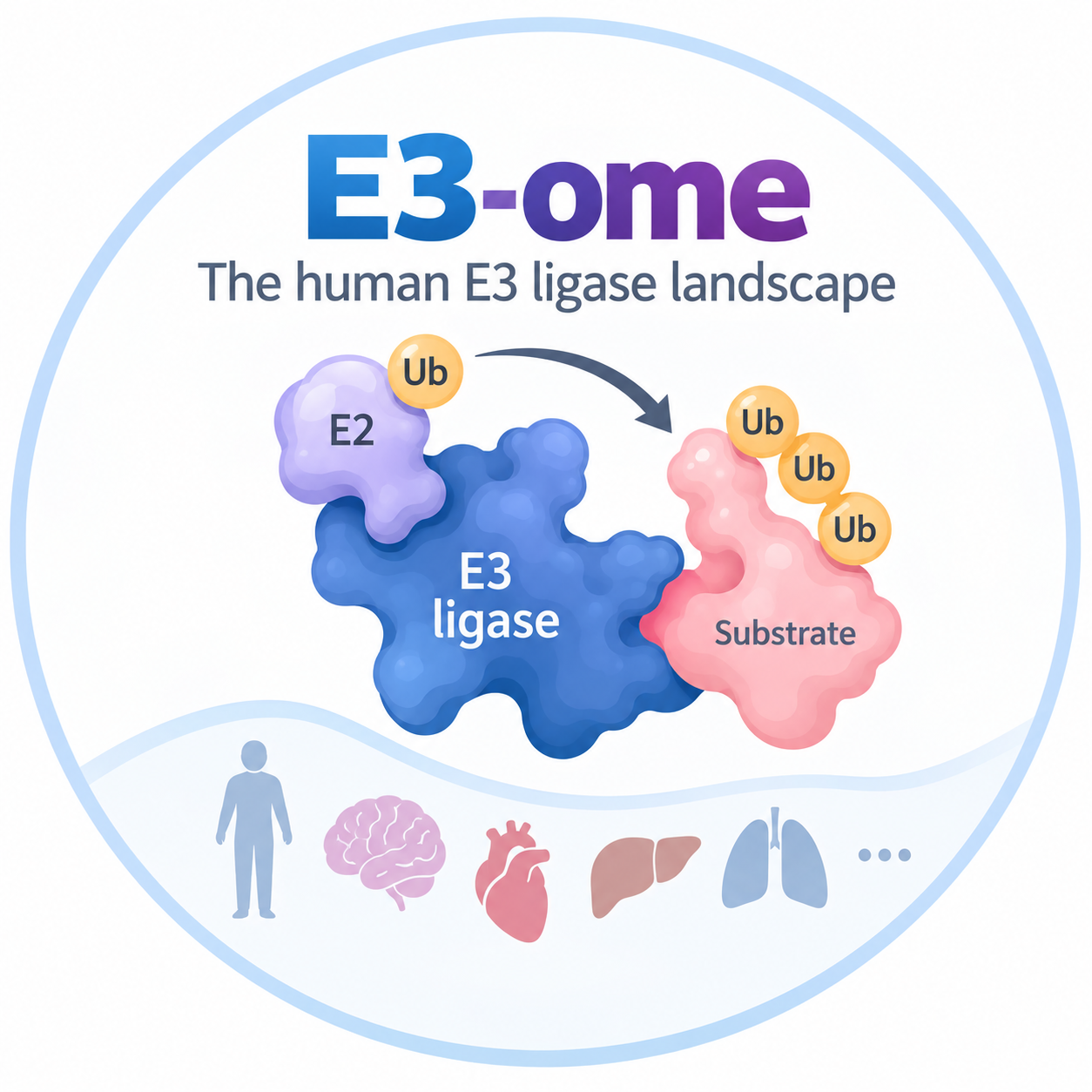
To define and systematically characterize the human E3 ubiquitin ligase (E3) landscape, we generated the E3-ome, a compendium of E3s encoded by the human genome. The E3-ome integrates experimental data, bioinformatics, and published research, revealing 672 high-confidence E3s. We standardized E3 classifications to create a unified framework for annotation and comparative analysis. The E3-ome identified several previously unrecognized domains, motifs, E3 candidates, and relationships, expanding the diversity of E3s. Furthermore, the E3-ome mapped the spatial and physiological organization of E3s across human tissues and cell types, revealing context-dependent E3s. Genetic analyses identified disease-associated variants across the E3-ome, linking E3s to diverse human pathologies. Together, these analyses define the human E3 landscape at high resolution and deliver a foundational resource to drive mechanistic and therapeutic discovery.
Citation
@article{kiat_chua2026,
  author = {Kiat Chua, Ngee and J González-Robles, Tania and J
    Reddington, Cameron and Dudley-Fraser, Jane and W Birkinshaw,
    Richard and Han, Jiru and Solano, Ashleigh and Wei Wong, Soon and
    Kochańczyk, Tomasz and J Peter, Joshua and A Nakasone, Mark and
    Aust, Florian and Munro, Jacob and Huei Tong, Yeh and Iskander,
    Julie and Abeysekera, Waruni and Garnham, Alex and Huckstep, Hannah
    and E Ritchie, Matthew and Wertz, Ingrid and Hymowitz, Sarah and
    Kumar, Sharad and C Conaway, Ron and G Privé, Gilbert and N Bullock,
    Alex and J Babon, Jeffrey and E Klevit, Rachel and Lorenz, Sonja and
    Ciulli, Alessio and S Fischer, Eric and H Thomä, Nicolas and P
    Nowak, Radosław and A Schulman, Brenda and Rapé, Michael and
    Rittinger, Katrin and K Pagan, Julia and Bahlo, Melanie and P
    Mackay, Joel and D Mace, Peter and D Lima, Christopher and T Hay,
    Ronald and Komander, David and C Lechtenberg, Bernhard and A P
    Joazeiro, Claudio and Pagano, Michele and Hofmann, Kay and Feltham,
    Rebecca},
  title = {The {E3-ome} Gene-Centric Compendium Reveals the Human {E3}
    Ligase Landscape},
  journal = {Cell},
  volume = {189},
  number = {7},
  date = {2026-04-02},
  url = {https://doi.org/10.1016/j.cell.2026.01.029},
  doi = {10.1016/j.cell.2026.01.029},
  langid = {en},
  abstract = {To define and systematically characterize the human E3
    ubiquitin ligase (E3) landscape, we generated the E3-ome, a
    compendium of E3s encoded by the human genome. The E3-ome integrates
    experimental data, bioinformatics, and published research, revealing
    672 high-confidence E3s. We standardized E3 classifications to
    create a unified framework for annotation and comparative analysis.
    The E3-ome identified several previously unrecognized domains,
    motifs, E3 candidates, and relationships, expanding the diversity of
    E3s. Furthermore, the E3-ome mapped the spatial and physiological
    organization of E3s across human tissues and cell types, revealing
    context-dependent E3s. Genetic analyses identified
    disease-associated variants across the E3-ome, linking E3s to
    diverse human pathologies. Together, these analyses define the human
    E3 landscape at high resolution and deliver a foundational resource
    to drive mechanistic and therapeutic discovery.}
}