Haemoglobin thresholds to define anaemia from age 6 months to 65 years estimates from international data sources
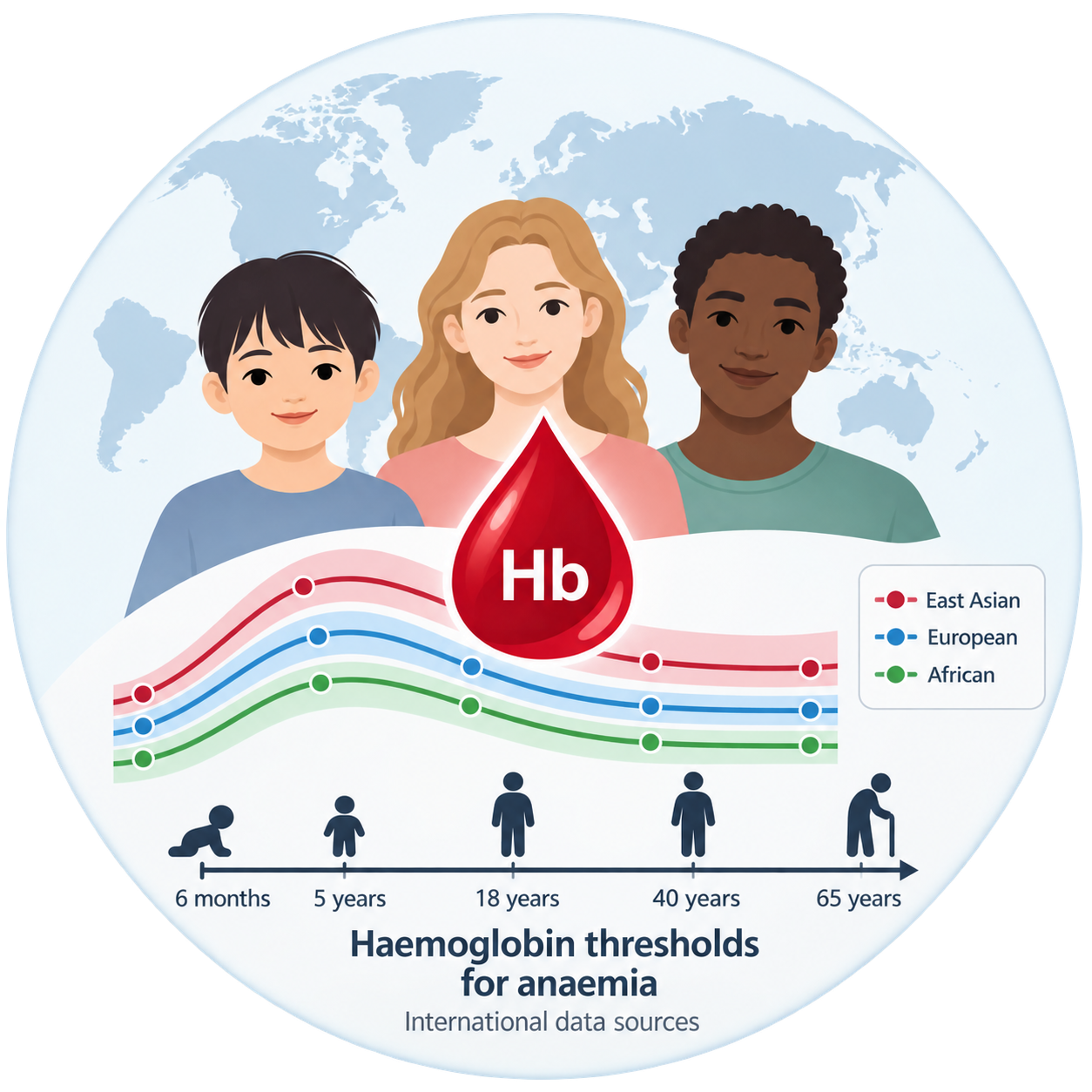
Detection of anaemia is crucial for clinical medicine and public health. Current WHO anaemia definitions are based on statistical thresholds (fifth centiles) set more than 50 years ago. We sought to establish evidence for the statistical haemoglobin thresholds for anaemia that can be applied globally and inform WHO and clinical guidelines. We identified eight data sources comprising 18 individual datasets that were eligible for inclusion in the analysis. In pooled analyses, the haemoglobin fifth centile was 104·4 g/L (90% CI 103·5-105·3) in 924 children aged 6-23 months, 110·2 g/L (109·5-110·9) in 1874 children aged 24-59 months, and 114·4 g/L (113·6-115·2) in 1839 children aged 5-11 years. Values diverged by sex in adolescents and adults. In pooled analyses, the fifth centile was 122·2 g/L (90% CI 121·3-123·1) in 1741 female adolescents aged 12-17 years and 128·2 g/L (126·4-130·0) in 1103 male adolescents aged 12-17 years. In pooled analyses of adults aged 18-65 years, the fifth centile was 119·7 g/L (90% CI 119·1-120·3) in 3640 non-pregnant females and 134·9 g/L (134·2-135·6) in 2377 males. Fifth centiles in pregnancy were 110·3 g/L (90% CI 109·5-111·0) in the first trimester (n=772) and 105·9 g/L (104·0-107·7) in the second trimester (n=111), with insufficient data for analysis in the third trimester. There were insufficient data for adults older than 65 years. We did not identify ancestry-specific high prevalence of non-clinically relevant genetic variants that influence haemoglobin concentrations.
Citation
@article{braat2024,
  author = {Braat, Sabine and L Fielding, Katherine and Han, Jiru and E
    Jackson, Victoria and Zaloumis, Sophie and Xu Hui Xu, Jessica and
    Moir-Meyer, Gemma and M Blaauwendraad, Sophia and W V Jaddoe,
    Vincent and Gaillard, Romy and C Parkin, Patricia and M Borkhoff,
    Cornelia and D G Keown-Stoneman, Charles and S Birken, Catherine and
    L Maguire, Jonathon and \& Health Research Team, Genes and Bahlo,
    Melanie and M Davidson, Eliza and Pasricha, Sant-Rayn},
  title = {Haemoglobin Thresholds to Define Anaemia from Age 6 Months to
    65 Years Estimates from International Data Sources},
  journal = {The Lancet Haematology},
  volume = {11},
  number = {4},
  date = {2024-02-29},
  url = {https://doi.org/10.1016/s2352-3026(24)00030-9},
  doi = {10.1016/S2352-3026(24)00030-9},
  langid = {en},
  abstract = {Detection of anaemia is crucial for clinical medicine and
    public health. Current WHO anaemia definitions are based on
    statistical thresholds (fifth centiles) set more than 50 years ago.
    We sought to establish evidence for the statistical haemoglobin
    thresholds for anaemia that can be applied globally and inform WHO
    and clinical guidelines. We identified eight data sources comprising
    18 individual datasets that were eligible for inclusion in the
    analysis. In pooled analyses, the haemoglobin fifth centile was
    104·4 g/L (90\% CI 103·5-105·3) in 924 children aged 6-23 months,
    110·2 g/L (109·5-110·9) in 1874 children aged 24-59 months, and
    114·4 g/L (113·6-115·2) in 1839 children aged 5-11 years. Values
    diverged by sex in adolescents and adults. In pooled analyses, the
    fifth centile was 122·2 g/L (90\% CI 121·3-123·1) in 1741 female
    adolescents aged 12-17 years and 128·2 g/L (126·4-130·0) in 1103
    male adolescents aged 12-17 years. In pooled analyses of adults aged
    18-65 years, the fifth centile was 119·7 g/L (90\% CI 119·1-120·3)
    in 3640 non-pregnant females and 134·9 g/L (134·2-135·6) in 2377
    males. Fifth centiles in pregnancy were 110·3 g/L (90\% CI
    109·5-111·0) in the first trimester (n=772) and 105·9 g/L
    (104·0-107·7) in the second trimester (n=111), with insufficient
    data for analysis in the third trimester. There were insufficient
    data for adults older than 65 years. We did not identify
    ancestry-specific high prevalence of non-clinically relevant genetic
    variants that influence haemoglobin concentrations.}
}