Identification of novel vertebral development factors through UK Biobank candidate gene search and body imaging analysis
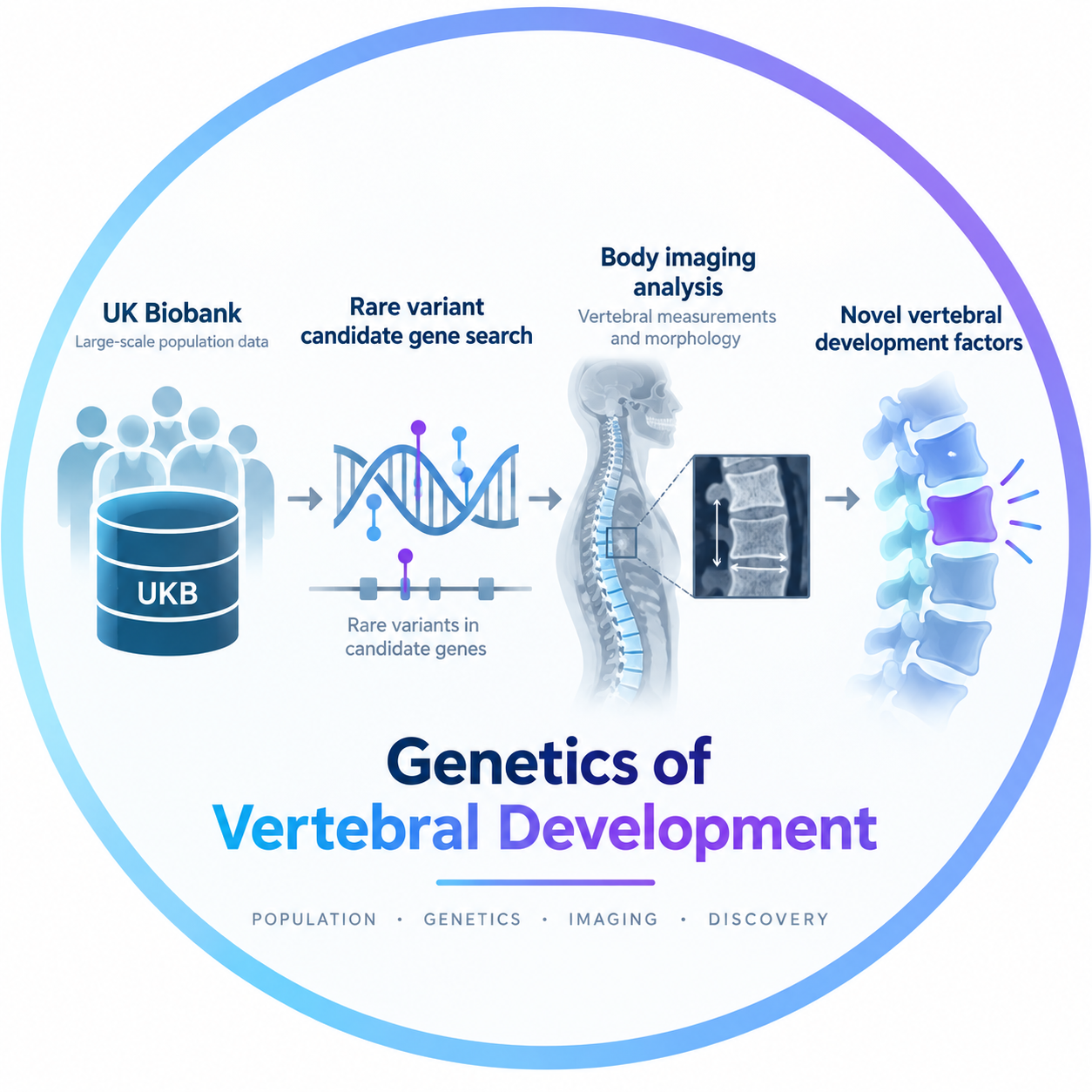
Numerical variations and transitional anatomy in the human vertebral column represent a significant yet understudied aspect of skeletal development with potential effects on multiple physiological systems. Utilising UK Biobank data, we integrated genetic analysis with deep learning-based multi-modal body imaging to investigate genetic factors associated with thoracic and lumbar spine anatomy. We identified three key genes, GPC3, NR6A1, and VRTN, associated with numerical variations of the lumbar vertebrae and ribs, with VRTN reported for the first time in humans as influencing vertebral development. Our findings reveal significant associations between these genetic variants, vertebral and rib anomalies, and increased prevalence of chronic pain. This study highlights the genetic underpinnings of vertebral development and demonstrates the utility of combining imaging and genetic data to uncover skeletal variation and its health implications for population health.
Citation
@article{sun#2025,
  author = {Sun\#, Zhuopin and Han\#, Jiru and G Fearnley, Liam and
    McGlinn, Edwina and Bahlo, Melanie},
  title = {Identification of Novel Vertebral Development Factors Through
    {UK} {Biobank} Candidate Gene Search and Body Imaging Analysis},
  journal = {Communications Biology},
  volume = {8},
  date = {2025-11-19},
  url = {https://doi.org/10.1038/s42003-025-09021-8},
  doi = {10.1038/s42003-025-09021-8},
  langid = {en},
  abstract = {Numerical variations and transitional anatomy in the human
    vertebral column represent a significant yet understudied aspect of
    skeletal development with potential effects on multiple
    physiological systems. Utilising UK Biobank data, we integrated
    genetic analysis with deep learning-based multi-modal body imaging
    to investigate genetic factors associated with thoracic and lumbar
    spine anatomy. We identified three key genes, GPC3, NR6A1, and VRTN,
    associated with numerical variations of the lumbar vertebrae and
    ribs, with VRTN reported for the first time in humans as influencing
    vertebral development. Our findings reveal significant associations
    between these genetic variants, vertebral and rib anomalies, and
    increased prevalence of chronic pain. This study highlights the
    genetic underpinnings of vertebral development and demonstrates the
    utility of combining imaging and genetic data to uncover skeletal
    variation and its health implications for population health.}
}