Population-level genome-wide STR discovery and validation for population structure and genetic diversity assessment of Plasmodium species
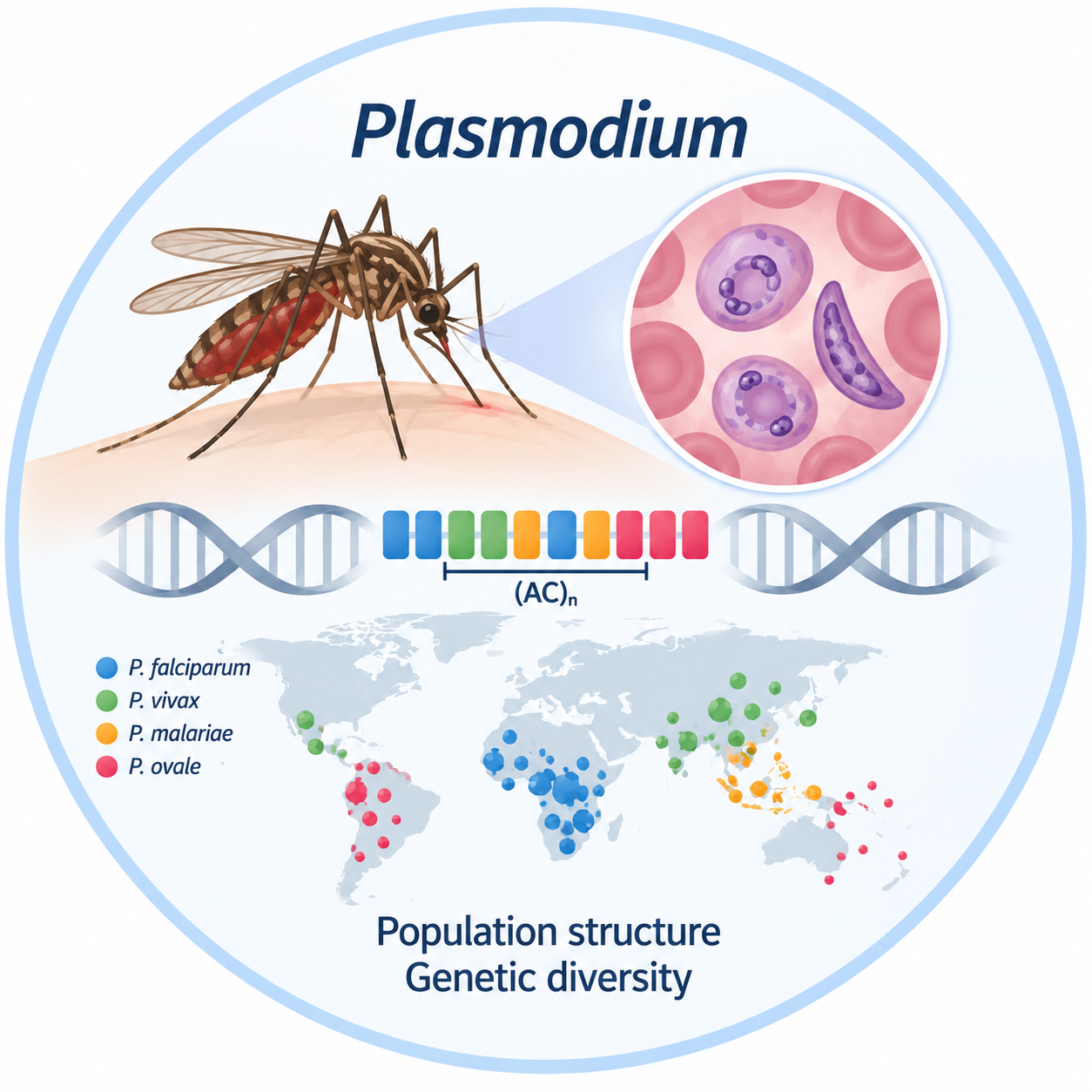
Short tandem repeats (STRs) are highly informative genetic markers that have been used extensively in population genetics analysis. They are an important source of genetic diversity and can also have functional impact. Despite the availability of bioinformatic methods that permit large-scale genome-wide genotyping of STRs from whole genome sequencing data, they have not previously been applied to sequencing data from large collections of malaria parasite field samples. Here, we have genotyped STRs using HipSTR in more than 3,000 Plasmodium falciparum and 174 Plasmodium vivax published whole-genome sequence data from samples collected across the globe. High levels of noise and variability in the resultant callset necessitated the development of a novel method for quality control of STR genotype calls. A set of high-quality STR loci (6,768 from P. falciparum and 3,496 from P. vivax) were used to study Plasmodium genetic diversity, population structures and genomic signatures of selection and these were compared to genome-wide single nucleotide polymorphism (SNP) genotyping data. In addition, the genome-wide information about genetic variation and other characteristics of STRs in P. falciparum and P. vivax have been available in an interactive web-based R Shiny application PlasmoSTR (https://github.com/bahlolab/PlasmoSTR).
Citation
@article{han2022,
  author = {Han, Jiru and E. Munro, Jacob and Kocoski, Anthony and E.
    Barry, Alyssa and Bahlo, Melanie},
  title = {Population-Level Genome-Wide {STR} Discovery and Validation
    for Population Structure and Genetic Diversity Assessment of
    {Plasmodium} Species},
  journal = {PLOS Genetics},
  volume = {18},
  number = {1},
  date = {2022-01-10},
  url = {https://doi.org/10.1371/journal.pgen.1009604},
  doi = {10.1371/journal.pgen.1009604},
  issn = {1553-7358},
  langid = {en},
  abstract = {Short tandem repeats (STRs) are highly informative genetic
    markers that have been used extensively in population genetics
    analysis. They are an important source of genetic diversity and can
    also have functional impact. Despite the availability of
    bioinformatic methods that permit large-scale genome-wide genotyping
    of STRs from whole genome sequencing data, they have not previously
    been applied to sequencing data from large collections of malaria
    parasite field samples. Here, we have genotyped STRs using HipSTR in
    more than 3,000 Plasmodium falciparum and 174 Plasmodium vivax
    published whole-genome sequence data from samples collected across
    the globe. High levels of noise and variability in the resultant
    callset necessitated the development of a novel method for quality
    control of STR genotype calls. A set of high-quality STR loci (6,768
    from P. falciparum and 3,496 from P. vivax) were used to study
    Plasmodium genetic diversity, population structures and genomic
    signatures of selection and these were compared to genome-wide
    single nucleotide polymorphism (SNP) genotyping data. In addition,
    the genome-wide information about genetic variation and other
    characteristics of STRs in P. falciparum and P. vivax have been
    available in an interactive web-based R Shiny application PlasmoSTR
    (https://github.com/bahlolab/PlasmoSTR).}
}